
The Learning Gap You Didn’t See Coming: Rethinking Training for Experienced Engineers

We often design training with beginners in mind, focusing on building foundational skills and introducing procedures while also ensuring compliance. But what happens when the learner is a 25-year veteran engineer who has already seen it all, from plant turnarounds to process equipment redesigns and everything in between?
Experienced engineers bring a wealth of expertise, but that same expertise changes how they learn and what they value. Treating them like novices can backfire, leading to frustration or “I already know this” syndrome.
Seasoned engineers learn differently than new engineers. Understanding those differences is essential to building a strong learning culture and designing effective engineering training that aligns with how experts really absorb and apply information.
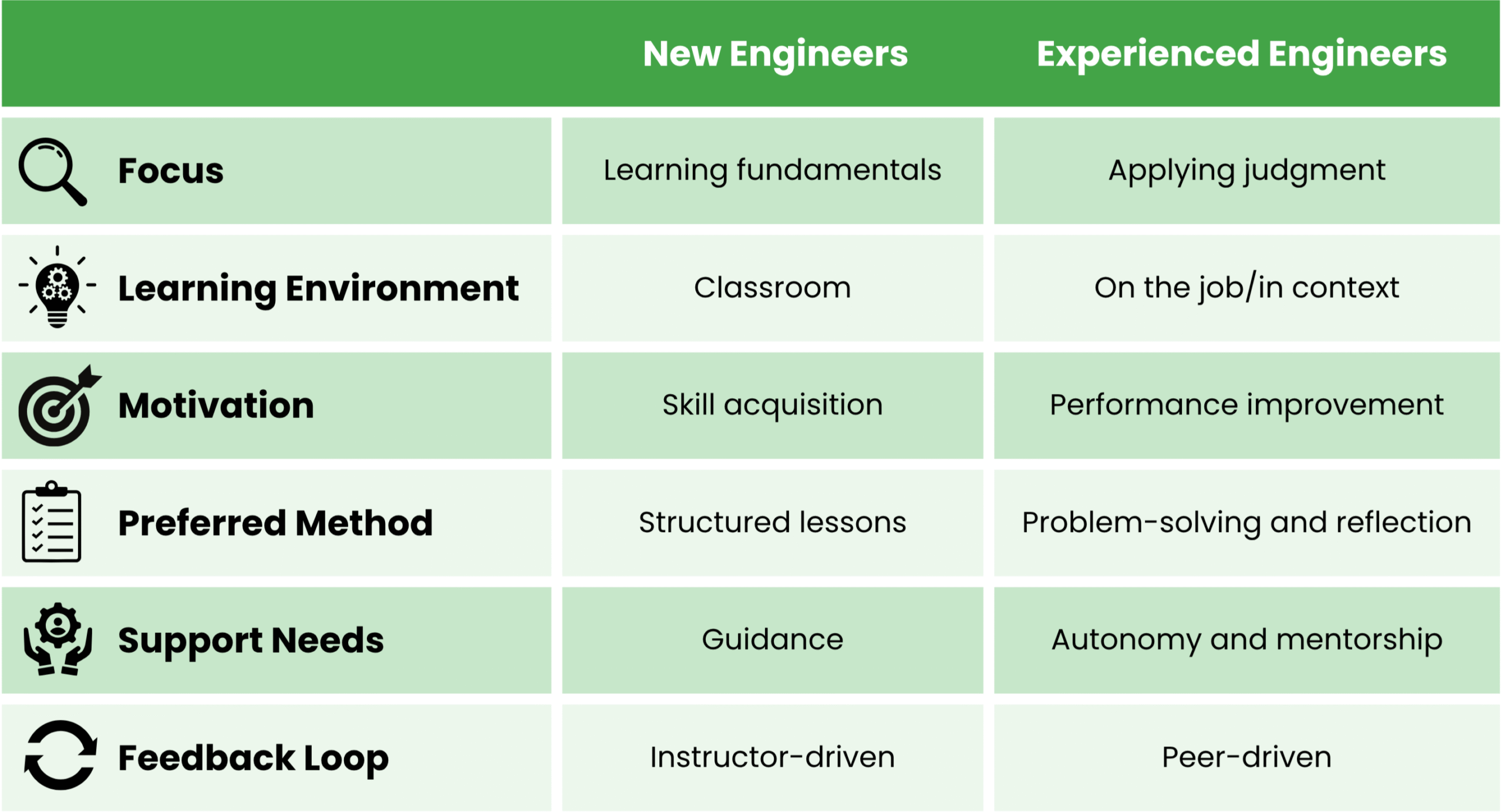
Learning differences between new and experienced engineers
How do experienced engineers learn differently?
-
They build on deep, existing knowledge.
Experienced engineers rely on accumulated problem-solving and prior exposure rather than step-by-step instruction.
They don’t start from scratch, so we shouldn’t train them as though they do. Their mental schemas are rich, interconnected, and shaped by years of troubleshooting and project experience.
Psychologist Alexander Kalyuga calls this the “expertise reversal effect.” Instructional methods that help beginners (like step-by-step guidance) actually hinder experts, who prefer solving authentic, complex problems on their own.
In other words: once you know how to drive, you don’t need someone narrating every turn. This means experienced engineers benefit from challenge-based learning, not handholding.
-
They learn best in context.
Research consistently shows that engineers learn most effectively through their work, not apart from it.
A study on professional learning in engineering practice from the University of Technology Sydney notes:
“Professional engineers’ learning is situated in practice — embedded in projects, collaboration, and material artifacts rather than in formal instruction.”
Case studies, simulations, after-action reviews, and real project debriefs are far more impactful than classroom lectures. Learning should happen in the flow of work and in a timely fashion rather than as a separate event.
-
They’re self-directed and relevance-driven.
Self-directed learning is essential in engineering training because relevance drives engagement.
Time is a precious commodity for senior engineers. They won’t engage with training unless it’s clearly relevant to their current challenges or future goals.
The National Academy of Engineering puts it simply:
“Even engineers with extensive experience are vulnerable to being outdated… Lifelong learning is a necessity, not an option.”
That’s why modular, on-demand learning resonates so strongly. It empowers engineers to learn what they need, when they need it, instead of sitting through content that doesn’t apply.
-
They value collaboration and tacit knowledge.
Much of what seasoned engineers know can’t be found in a manual. It’s tacit knowledge built from experience and judgment. The best learning happens in conversation with peers, such as when troubleshooting a problem or sharing lessons learned from a failure.
An experience-led learning approach helps capture and share that knowledge across teams before it walks out the door. Structured mentoring programs and peer learning forums grounded in reflective practice help keep that expertise alive.
How can you design more effective training for experienced engineers?
Once you understand how seasoned professionals learn, you can design learning that sticks. Here’s how to make the shift.
-
Start with competencies, not courses.
Begin training design by aligning competencies with business outcomes.
Rather than offering generic training, map specific skills and competencies to organizational goals. Use competency assessments to identify where your engineers already excel and where they need targeted development.
This approach allows organizations to tailor learning pathways that respect experience while addressing emerging skill gaps such as digitalization, reliability analytics, or sustainability.
-
Blend formal and informal learning.
A blended learning model helps engineering teams apply skills on the job.
Experienced engineers thrive in hybrid environments that combine structured training with hands-on, on-the-job application. Integrating workshops, mentoring, and on-demand content allows for learning that is both formal and fluid, as well as accessible when it is needed most.
-
Use real-world scenarios and reflection.
Case studies deepen understanding and strengthen professional judgment.
Learning for experts should focus less on “how to” and more on “why,” “when,” and “what if.” Scenario-based learning and case study reviews invite critical thinking and spark valuable discussions.
For example, post-incident reviews or failure analyses can serve as powerful reflective exercises, helping experienced engineers reframe what they already know through new perspectives.
-
Encourage social and cross-generational learning.
Pairing seasoned engineers with early-career professionals accelerates development for those who are new to their positions. But it also helps the experts reflect on and codify their own tacit knowledge.
This structure allows knowledge transfer to become intentional, not incidental.
Connecting insights to practice
Experienced engineers don’t need more information. They need the right challenges, at the right time, in the right format.
If companies recognize this and design learning that builds on existing expertise, they set the stage for the next level of organizational performance. Continuous learning keeps experienced engineers (and the organizations they support) competitive and ready for what’s next.
At Becht, we’ve long recognized that no two engineers or learning journeys are alike. Our Learning & Development approaches are designed for engineers at every stage of their careers, but especially for those whose experience runs deep. Through the BechtCONNECT digital platform, tailored training, and skills and competency frameworks, we help organizations:
- Deliver learning that meets engineers where they are
- Embed learning in work (not apart from it)
- Capture and transfer critical institutional knowledge
When experienced engineers keep learning, organizations keep advancing to meet evolving industry demands. Contact Becht to strengthen learning within your team.
Like what you just read? Join our email list for more expert insights and industry updates.
References
- Kalyuga, A., et al. Cognitive Load Theory and the Expertise Reversal Effect. Educational Psychologist, 2003.
- Reich, A., et al. Engineers’ Professional Learning: A Practice Theory Perspective. University of Technology Sydney, 2014.
- National Academy of Engineering. Lifelong Learning and Today’s Engineer. National Academies Press, 2012.
- Royal Academy of Engineering. Experience-led Learning for Engineers: A Good Practice Guide. ThinkUp/RAEng, 2016.