Improving Fired Heater Efficiency Without Major Capital Investment
Fired heater efficiency can often be improved without major capital investment by identifying operating or maintenance issues that are reducing performance. Consistent monitoring helps facilities recognize these opportunities before assuming equipment upgrades are necessary.
Key takeaways
- Excess air is often one of the most accessible opportunities for improving fired heater efficiency.
- Performance trending can reveal gradual efficiency losses before they become significant problems.
- Upstream fouling can force a heater to fire harder even when the heater itself is operating properly.
- Reliable instrumentation is essential for identifying the true cause of performance issues.
- Clear ownership helps facilities sustain fired heater efficiency improvements over time.
Improving fired heater efficiency doesn’t always require a major equipment upgrade. In my experience, some of the best opportunities come from understanding how the heater is actually operating and paying attention when its performance begins to change. Relatively simple problems can often be corrected before they become bigger ones. The challenge is that somebody has to be looking for them!
I’ve been to sites where one person really knew the fired heaters inside and out. I’ve also visited facilities where the heater had clearly been neglected, and the difference is evident. I like to compare it to owning a car that you really care about: you know how it normally sounds and performs, so when something changes, you notice.
Fired heaters benefit from this same kind of mindset. The responsibility might fall to a fired equipment specialist or engineer, a process engineer, or simply anyone who feels committed to championing fired heaters for the site. Regardless of the job title, what’s most important is for a facility to have someone who understands the heater and follows its performance closely. If you’re searching for opportunities that don’t immediately require capital spending, that’s where I would start. From there, it comes down to knowing where to look and paying attention to what the heater is telling you.
How can excess air and draft affect fired heater efficiency?
When I evaluate a fired heater for efficiency opportunities, excess air is usually the low-hanging fruit, with draft closely connected to it. If I walk up to a natural draft furnace at a normal firing rate and it’s operating at 6% or 7% O₂, it may be possible to bring that down. A common rule of thumb is that every 2% reduction in O₂ can provide roughly a 1% improvement in efficiency.
But the right O₂ target depends on the heater and the conditions you’re operating under. Fuel variability matters, as do the controls and instrumentation available to respond to that variability. I’ve observed sites operating at 5-6% O₂ where trying to force the heater down to 3% wouldn’t be a safe operating decision.
Draft presents a similar issue: sometimes I’ll find a stack damper left 100% open because that’s just where everyone is comfortable operating it. Establishing a safe operating point can help reduce unnecessary inefficiency without requiring frequent damper adjustments.
Local conditions can influence that decision as well. A facility in an area with significant wind may need to operate with higher draft to keep the heater stable. Ultimately, fired heater efficiency needs to be optimized within the safe operating envelope of the equipment.
Don’t rely on an O₂ reading without understanding the measurement
I think of excess O₂ as one of the heater’s speedometers: it’s an important indication of what’s happening, but you need to know that the speedometer is telling you the truth. I’ve seen O₂ analyzers installed in locations where they weren’t giving a representative reading. Analyzers can also drift if they aren’t being properly maintained and calibrated.
One experience from earlier in my career really drove this home. I was the fired equipment focal point at a facility and a new inspector asked me to walk him through one of our heaters. I decided to give him a thorough tour, so we climbed all the way to the top of the heater – somewhere people don’t necessarily go unless they have a reason.
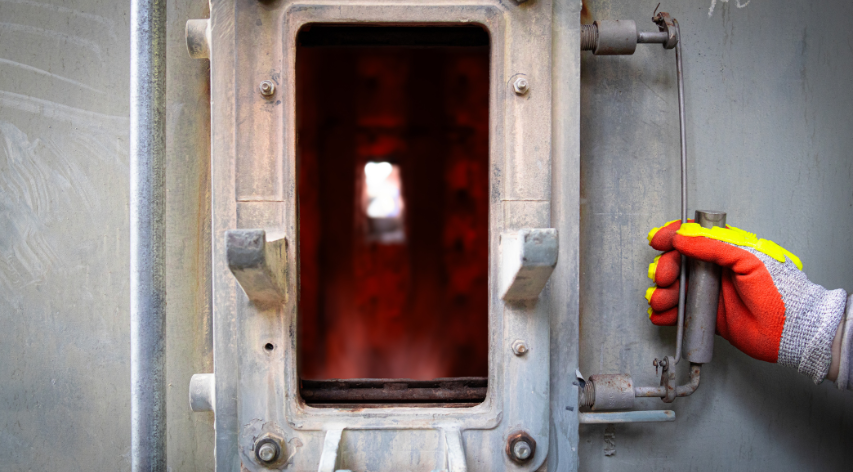
I looked down toward an expansion below and saw what I initially thought was something painted bright red. But once my eyes adjusted, I realized I was looking straight through a hole in the furnace! It was a huge find because the O₂ measurement was downstream of the opening, so our reading had always looked good. In reality, the hole was pulling air into the heater before the measurement point. We potentially could have been starving the burners for air while still seeing an O₂ reading that appeared acceptable.
That’s exactly why I don’t like relying on a single number to tell me whether a heater is operating properly. You need to understand where the measurement is coming from first –then compare the data with what the equipment itself is telling you.
Why is trending fired heater performance important?
A single operating value only tells you where the heater is at that moment, but I want to know where it has been going. Firing rate and stack temperature are two parameters I like to see trended. If firing starts increasing for the same process duty, I want to understand why.
Some sites display firing rate as a percentage – where normal operation might be 100% and increased firing becomes 110% or 120% – while others use an actual firing rate. I don’t have a strong preference for how it’s displayed. What I care about is being able to look at the control panel screens and quickly understand where it is operating compared with where it normally operates.
Trending is also how you catch gradual changes. If a heater doesn’t have someone routinely reviewing its performance, efficiency can move in the wrong direction without attracting much attention. I’ve worked at facilities where the energy culture was so strong that even the plant manager watched O₂ levels. That kind of attention makes it much easier to recognize when the heater begins moving away from its normal operating baseline.
Fired heater efficiency problems can start upstream
Sometimes a heater appears inefficient because you’re asking it to compensate for a problem somewhere else. Crude and vacuum units are good examples. If upstream exchangers become fouled and the inlet temperature into the furnace drops, the heater has to fire harder to make up the difference. You can tune that furnace all you want, but you’re overlooking an important part of the problem if you aren’t looking upstream.
Internal coking (fouling) creates a similar problem within the heater. Coke acts as an insulator, reducing heat transfer and driving higher tube metal temperatures. The furnace then has to fire harder to deliver the required process duty. I had a call recently where a facility was seeing increasing tube metal temperatures. Thermography helped identify that they had coke buildup. That kind of information should lead you to ask why the heater is requiring additional firing. From there, you can determine whether the underlying heat-transfer problem needs to be addressed.
This is also why I put a lot of emphasis on decoking practices. Rushing a decoke can leave you operating inefficiently afterward. Delaying one that needs to happen can create problems, too, especially if the work isn’t properly verified when it is eventually performed.
I once heard a story from a pigging operator about a crew that arrived at a site without the pigs they needed. They circulated water for several days and ultimately told the facility the heater was clean. There’s a broader lesson in that example: you own your equipment. A vendor can perform the work, but the facility should have its own QA/QC procedure and verification process. You’re much more likely to get the outcome you want when somebody from the facility understands what should be happening and stays involved throughout the work, asking questions along the way to make sure it’s done properly.
How does tramp air reduce fired heater efficiency?
Tramp air is another area where I see surprisingly simple opportunities get missed. After a turnaround, tube penetration seals may not be put back in place. I’ve even seen maintenance or instrumentation personnel remove tube sleeves to use as knee pads while they’re working on a platform and then forget to put them back. Observation doors also get left open. Those openings can affect how the heater operates.
We once visited a facility and noticed while walking the site that all of the observation windows on one heater were open. They were struggling with inadequate combustion air, so opening the observation windows had become part of how they were dealing with the problem. This was also a potentially dangerous situation because the burners may not have been receiving enough air for complete combustion. We were able to identify what was happening and help them address the underlying issue. After some education and discussion with the people responsible for the equipment, we saw the operating culture begin to change.
That’s one reason I consider our thermography personnel some of our “first responders” for fired heaters. Sure, they’re looking at tube temperatures, but they’re also walking the heater and seeing the condition of the equipment firsthand. Sometimes they’ll spot something that doesn’t look right and end up finding an efficiency or safety opportunity along the way.
Burner performance can deteriorate gradually
Burner performance is another area where familiarity can work against you. If you look at the same burners every shift, gradual deterioration can become normal to your eye: a plugged gas tip or irregular flame pattern may develop slowly enough that people get used to seeing it.
Routine rounds are important because burner condition can change from one shift to the next, and poor combustion can quickly affect heat transfer. Thermography adds another layer of information by showing whether tube temperatures are changing. What I want to see is an operating team that understands how the heater normally behaves, which makes it easier to recognize when something begins to deviate from the baseline.
And maintenance needs to follow that same discipline. I’ve experienced cases where burner maintenance delayed until the problem became significantly harder to ignore. I’ve also watched facilities try to save money by sending burner gas tips to a local fabrication shop to have them reverse-engineered instead of returning to the OEM. In my experience, that approach has gone wrong too many times. Burner manufacturers invest heavily in developing those components and manufacturing them correctly. Unless there’s a known problem with the original design, I’m cautious about replacing engineered parts with something that hasn’t gone through the same development process and is subject to strong manufacturing tolerances. Saving a relatively small amount on a component can be a poor trade if it compromises heater performance.
Reliable instrumentation is essential to fired heater optimization
Instrumentation deserves similar scrutiny since poor data can easily push you toward the wrong conclusion. I saw this on a new reformer installation where a UV flame scanner had been selected. It worked well while the reformer was firing natural gas, but when the fuel switched to PSA gas, the scanner dropped out because the application actually required a UV/IR scanner. The unit ended up tripping because the instrument selected for the application couldn’t reliably detect the flame under the different firing condition.
The lesson I take from situations like this one is that you need the right instrument for the application. I also pay attention to what a facility already knows how to operate and maintain. When someone asks me which technology is best, I respond with a question of my own: what does your site already use successfully? Standardization and familiarity have real value, so if several good options are available, choosing one and using it consistently across a fleet of heaters can be very beneficial.
Before blaming the heater itself – or deciding that a major investment is necessary – make sure the information you’re using to diagnose the problem is reliable.
When does improving fired heater efficiency require capital investment?
There are going to be cases where tuning or maintenance can only take you so far and you really do need to invest in the equipment. Before you get to that point, though, I believe in doing the engineering work to understand what’s actually limiting you. A well-defined study can take your operating data and compare where the heater is today with where you want it to be. From there, you can start to understand what needs to change.
Having a clear goal is important. I’ve seen studies performed without a defined target, and then the recommendations were never implemented. I always want to start by asking: where are we trying to get to? Once you know that, you can figure out what’s keeping you from getting there.
You may find that instrumentation is limiting you, or maybe an upstream exchanger needs to be cleaned. You could also find that the equipment itself is the constraint. Once you understand the problem, you can make a much better decision about whether a capital project is really what the heater needs.
Sustaining fired heater efficiency requires ownership
If I could leave facilities with one recommendation for improving fired heater efficiency without major capital spending, it would be to give somebody clear ownership of the heaters.
I’ve witnessed the difference when a fired equipment focal point is passionate about the equipment: that person pays attention to air leakage and monitors performance trends closely enough to recognize when something changes. They make a point of following up on maintenance because they understand how the heater is supposed to operate. I’ve also seen what happens when that ownership isn’t there. You can install monitoring tools and establish operating targets, but somebody needs to care enough to act on what those tools are telling them.
That sense of ownership is what turns relatively simple fired heater efficiency opportunities into sustained improvements. Know your heater and understand how it normally operates – then make sure somebody is responsible for recognizing when that begins to change.
Contact us today to connect with one of Becht’s fired heater specialists and identify practical opportunities to improve efficiency without unnecessary capital investment.
Or, if you’re interested in building your team’s practical understanding of fired heater operation and efficiency, explore our customizable fired heater training offerings by downloading the one-pager or visiting our training site.
Like what you just read? Join our email list for more expert insights and industry updates.