Renewable Processing Explained: How Feedstocks Become Usable Fuels
By Scott Sayles, Robert Ohmes, Pattabhi Raman Narayanan, and Jessica Hofmann
Renewable feedstocks require different processing technologies depending on their properties and the product being produced. Selecting the appropriate pathway is a critical step in turning a chosen feedstock into a usable renewable fuel.
Key takeaways
- Renewable processing technology should be selected based on the characteristics of the feedstock and desired product.
- Pretreatment prepares seed oils and animal fats for downstream conversion by removing contaminants.
- Pyrolysis and hydrothermal liquefaction provide different pathways for converting biomass into renewable intermediates.
- Existing refinery technologies such as FCC and hydroprocessing can be used to convert renewable feedstocks into transportation fuels.
- Renewable hydrogen can also serve as a building block for products such as green ammonia.
Selecting a feedstock is only the first step in a synthetic fuel project. Once the feed has been evaluated, the next decision to make is which processing technology will convert it into the desired product. Because different feedstocks require different processing approaches, choosing the right technology is a critical step in project development.
This blog is the second in a three-part series on renewable processing. It examines the major technologies used to convert renewable feedstocks into renewable fuels. The first article introduced the major categories of renewable feedstocks used in synthetic fuel production, and the final article will explore the fuel products generated through these processing pathways.
Major renewable processing technologies
Pretreatment
Pretreatment is often the first processing step for seed oils and animal fats. Rather than converting the feedstock, the process removes inorganic compounds and other contaminants before downstream conversion begins.
Pretreatment does not change the chemical composition of the feed. Instead, it prepares the material for subsequent processing through methods similar to those used in edible oil processing or hydrothermal treatment.
Pyrolysis
Pyrolysis converts dry biomass into liquid, gas, and solid products through rapid thermal decomposition in an oxygen-depleted environment. This process upgrades biomass into a material that can be used directly for combustion or processed further into renewable fuels. Thermal processing removes carbon while increasing the relative hydrogen content of the remaining material.
Before pyrolysis begins, biomass is typically dried to reduce moisture content and prepared to improve heat transfer. Some feedstocks also undergo torrefaction, a mild thermal treatment that increases energy density before entering the reactor.
The resulting pyrolysis oil is a dark, viscous liquid containing approximately 35–40 wt% oxygen. It typically contains about 40–55 wt% carbon and 6–10 wt% hydrogen, giving it a lower heating value of approximately 16–19 MJ/kg. Its composition contributes to characteristics such as corrosiveness, thermal instability, and immiscibility with conventional fossil fuels. Exposure to air can also cause the oil to polymerize, creating additional handling challenges. Despite these limitations, pyrolysis oil continues to gain attention for applications including chemical manufacturing, engines, turbines, and boilers.
Hydrothermal liquefaction (HTL)
Hydrothermal liquefaction (HTL) converts wet biomass into bio-crude oil under elevated temperatures and pressures. Because the process can handle feedstocks with high moisture content, it is well suited for materials such as sludge, food waste, and other wet biomass streams.
HTL typically operates between 250°C and 370°C and at pressures of 10 to 25 MPa. The resulting bio-crude has a high energy density with a lower heating value of approximately 33–37 MJ/kg. It contains 5–12 wt% oxygen along with renewable chemicals that support downstream fuel production.
Although HTL provides an effective way to recover value from wet biomass, projects must also address the management of aqueous by-products generated during processing.
Fluid catalytic cracking (FCC)
Fluid catalytic cracking (FCC) converts renewable liquid feedstocks into transportation fuels by removing a portion of the oxygen contained in triglycerides while producing products in the gasoline and diesel boiling ranges.
Compared with hydroprocessing, some oxygen remains in the products, and selectivity to liquid fuels is lower because triglyceride side chains already fall within the naphtha and diesel boiling ranges. Many refineries already operate FCC units, making this technology an attractive option for processing renewable feedstocks.
Hydroprocessing
Hydroprocessing is one of the primary technologies used to produce renewable diesel and sustainable aviation fuel (SAF). During this process, hydrogen reacts with renewable feedstocks to produce hydrocarbon fuels.
Both co-processing and dedicated renewable processing configurations are currently in use or under development, and approved production pathways already exist for renewable diesel and SAF.
Esterification
Esterification produces biodiesel by reacting fats and oils with alcohol, typically methanol, in the presence of a catalyst. The process forms Fatty Acid Methyl Ester (FAME) along with glycerin, which is used in pharmaceutical manufacturing. The reaction produces approximately 100 pounds of biodiesel and 10 pounds of glycerin from every 100 pounds of oil or fat processed.
Feedstocks range from soybean oil to used cooking oil. Emerging sources such as algae also continue to receive attention because of their potential productivity. Today, most biodiesel relies on methanol derived from conventional sources. Future adoption of renewable methanol would further increase the renewable content of FAME production.
Renewable molecule production
Hydrogen
Renewable hydrogen can be produced through electrolysis or biomass conversion pathways, as illustrated in Figure 1.
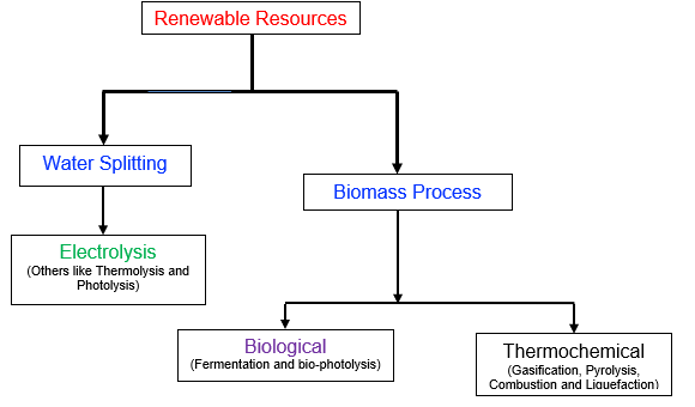
Figure 1: Hydrogen production pathways
Electrolysis uses renewable electricity from sources such as wind and solar power to split water into hydrogen and oxygen. Biomass can also be converted into hydrogen through biological or thermochemical pathways. Thermochemical processes rely on technologies such as gasification and pyrolysis to generate hydrogen-rich gases that undergo additional processing through water-gas shift and steam reforming reactions.
Biomass gasification remains one of the most economical approaches for renewable hydrogen production. During this process, solid biomass is converted into a gaseous mixture containing hydrogen, methane, carbon monoxide, carbon dioxide, and other compounds. Additional gas cleanup is required before hydrogen can be recovered for downstream use. Gasification typically operates between 700°C and 1200°C using oxygen, air, steam, or a combination of these media.
Pyrolysis also offers opportunities for hydrogen production because it operates without oxygen, reducing carbon oxide formation while enabling recovery of solid carbon. Ongoing advances continue to improve the economics and scalability of biomass-based hydrogen production, while electrolysis remains one of the leading pathways for lower-cost clean hydrogen.
Green ammonia
Green ammonia is produced by generating renewable hydrogen through electrolysis and combining it with nitrogen separated from air in a Haber-Bosch synthesis loop, as shown in Figure 2. This approach replaces conventional methane reforming with renewable electricity and supports carbon-free ammonia production.
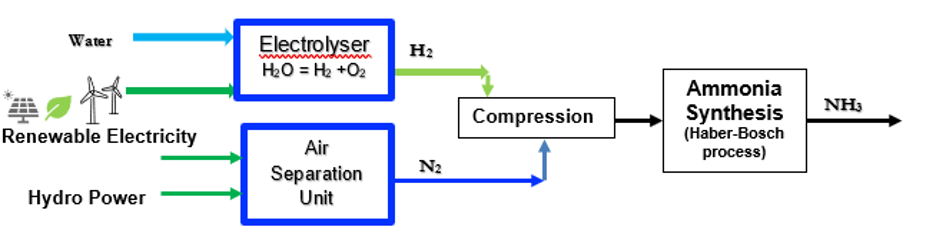
Figure 2: Green ammonia
Biomass provides additional pathways for renewable ammonia production. Gasification can produce syngas that is further processed into ammonia after carbon removal. Biomass can also be converted into biomethane or biogas for use as an ammonia feedstock. Although the required process steps have been commercially demonstrated, bio-ammonia has not yet reached widespread commercial production.
Interest in green ammonia continues to grow as more producers announce plans to integrate renewable hydrogen into existing facilities. According to the International Renewable Energy Agency (IRENA), the Haber-Bosch process is expected to remain the dominant technology for large-scale green ammonia production in the coming decades.
Building on the feedstock
The technologies discussed in this article provide the link between renewable feedstocks and the fuels they become. Understanding how these processes work helps organizations evaluate the most appropriate pathway for their project. The final article in this series explores the renewable fuel products generated through these processing technologies and their applications.
Considering a renewable fuels project? Becht helps clients evaluate every stage of renewable fuel production, from feedstock selection through technology evaluation and implementation. Contact us to start the conversation.
Like what you just read? Join our email list for more expert insights and industry updates.