
Improving Offshore Production Efficiency Through Better Maintenance Shutdown Planning

Offshore production efficiency can be improved by strengthening maintenance shutdown planning and execution. Many of the techniques recommended by industry reviews have already been proven in refinery turnarounds and major project environments.
Key takeaways
- Planned maintenance shutdowns remain a significant contributor to offshore production losses.
- Many recommendations from the UK Production Efficiency Task Force mirror established refinery turnaround practices.
- Scope control and detailed planning are critical to reducing shutdown duration and execution risk.
- Production efficiency improved after the Wood Review but has declined again in recent years.
- Offshore operators can improve results by adopting proven turnaround methodologies from refining and petrochemical industries.
More than a decade ago, the offshore oil and gas industry identified planned maintenance shutdowns as a major contributor to lost production and developed recommendations to improve their planning and execution. Those efforts initially delivered results, but production efficiency has since resumed its decline.
This is particularly striking because the recommended practices were already well established in onshore refinery turnarounds and major project organizations. Techniques such as scope control, phased planning, detailed scheduling, and risk management have long been used to improve execution performance in refining and petrochemicals.
The experience gained in those industries represents a valuable and largely untapped resource for offshore operators. There is a clear opportunity to adapt proven turnaround practices from the onshore world to strengthen maintenance shutdown execution and improve production efficiency.
The UKCS production efficiency decline and industry response
Production efficiency (PE) is an indication of how well an operator is performing. It compares actual production with the volume that could potentially have been produced.
In 2004, PE across the United Kingdom Continental Shelf (UKCS) was running at 81%. But by 2013, it had collapsed to around 60%. This significant decline prompted the UK government and industry to form a Production Efficiency Task Force (PETF) and commission a review to identify the underlying causes and develop recommendations for improvement. A target was set of increasing PE to 80% by 2016.
This review, known as the Wood Review, was issued in 2014. It noted that “the rapid fall in production efficiency is an indication of poor asset stewardship” and cited “poor project management, planning and execution efficiency” as contributors to this loss of PE.
The PETF determined that most of the production loss referred to in the Wood Review could be attributed to “unplanned plant losses and planned shutdowns” and stated that “the data reviewed by the PETF illustrated that production losses attributed to planned maintenance shutdowns (PMSDs) were identified as an area for significant improvement across the industry.”
To address this, the task force issued a pamphlet in July 2015 titled Guidance for the Efficient Execution of Planned Maintenance Shutdowns. The guidance focused on several practical measures for improvement, including:
- Developing long-range plans for PMSDs and planning for longer intervals between them in order to maximize the available production period over the life of the field
- Challenging the scope going into a PMSD to ensure only necessary work is included and identifying opportunities to complete other work during routine maintenance or unplanned outages
- Minimizing late scope additions (and deletions)
- Developing a detailed schedule for the execution phase of a PMSD
- Developing a Risk Register and managing the risks to PMSD success
- Carrying out a thorough execution schedule uncertainty and risk analysis in order to develop a realistic probabilistic range of completion dates
Lessons already proven onshore
With one exception, these recommendations were already well established across the onshore refining and petrochemicals industry. The final item – the recommendation to run probabilistic models of execution schedules – has long been used on major capital projects and is now beginning to gain traction in the onshore turnaround world.
The pamphlet also recommended a phased preparation and planning approach for PMSDs. This approach is routinely used onshore and was, in fact, originally adopted by the turnaround industry from capital project management.
None of these recommendations were revolutionary. They reflected established practices with a proven track record in turnaround and project environments. The only difference was that these techniques were already embedded in another part of the process industries.
Why production efficiency has started declining again
Following the issuance of the Wood Review and the guidance pamphlet, PE did briefly improve. By 2019 it was back at 80%. However, it remained at that level for only one more year. Since 2020, it has dropped again, and the latest report available (for 2024) puts production efficiency at only 75%. If the steady trend since 2022 continues, the PE percentage for 2025 will be even worse (see Figure 1 for details).
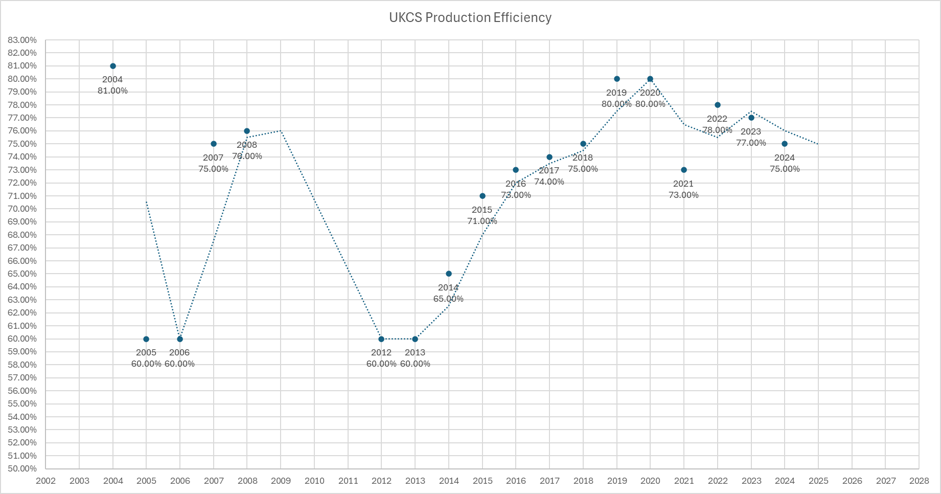
Figure 1: UK Continental Shelf production efficiency1
What offshore shutdown teams can learn from refinery turnarounds
In the period between the Wood Review and the return to 80% PE in 2019, several commentators – this author included2 – pointed out that the recommendations were all techniques that have been applied routinely by onshore turnaround and project teams for many years. As a result, onshore staff in refining and petrochemicals have valuable experience in shutdown planning and execution that could be transferred to the offshore world. In my 2017 article, I encouraged the offshore industry to focus on maintenance turnaround scope control, similar to that practiced onshore, and on maintenance turnaround interval extension.
Sadly, the PE data since 2020 suggests that the recommendations from the guidance pamphlet have not been embedded and that more needs to be done offshore to fully implement the techniques that are so commonplace onshore.
Closing the production efficiency gap
There are significant gains to be made in offshore oil and gas production efficiency, simply by improving the ways offshore planned maintenance shutdowns are organized, planned, and executed. These practices have been employed successfully by the onshore industry for many years. The offshore industry could accelerate progress by drawing on the experience and proven practices of onshore turnaround teams.
Need advice or counsel for improving your offshore planned maintenance shutdowns? Contact a Becht expert regarding your future plans.
References
1Data drawn from North Sea Transition Authority Reports
2Lawrence, G.R.: “C minus, Room for Improvement – Improving Offshore Maintenance Turnarounds in the UK North Sea” – OE (Offshore Engineer), August 2017, pp38-40.
Like what you just read? Join our email list for more expert insights and industry updates.