The Art of Catalyst Safety Assessment (CSA) in Fixed-Bed Reactors and Adsorbers

Catalyst Safety Assessment (CSA) is a method used to identify and manage risks in fixed-bed reactors by evaluating how catalysts interact with hydrocarbons and heat. It is especially important during transient conditions when the risk of uncontrolled reactions increases.
Key takeaways
- Catalyst Safety Assessment (CSA) evaluates how catalysts interact with hydrocarbons throughout their lifecycle.
- Transient conditions introduce higher risk than steady-state operation in fixed-bed systems.
- The CSA triangle highlights the interaction between metal oxide, hydrocarbon, and heat.
- Uncontrolled reactions can lead to rapid pressure increase and loss of containment.
Many processes within the hydrocarbon industry deploy fixed-bed reactors and adsorbers. Generally speaking, these systems operate well under steady-state conditions, but additional safety risks become apparent during transient conditions. There are multiple known incidents where transient operation of a fixed-bed reactor or adsorber has led to explosions, fires, and loss of primary content (LOPC).
Do you know how safe your operation of fixed-bed reactors and adsorbers is? After a major incident at its site in Moerdijk, the Netherlands, Shell introduced Catalyst Safety Assessment (CSA) as a mandatory tool when developing or deploying new process configurations involving fixed-bed catalysts or adsorbents. While this may not be commonly applied in industry yet, it is considered a good practice to avoid major incidents like the one at Shell Moerdijk.1
What is Catalyst Safety Assessment (CSA)?
Catalyst Safety Assessment (CSA) is a well-defined approach to assess a catalyst or adsorbent in relation to the hydrocarbon(s) it will be exposed to throughout all stages of its lifetime. The aim is to minimize associated risks by improving understanding of potential reactions and their consequences.
CSA was developed for applications using metal oxides as a starting point. Its basis can be described using a modified fire triangle, which we will call the CSA triangle.
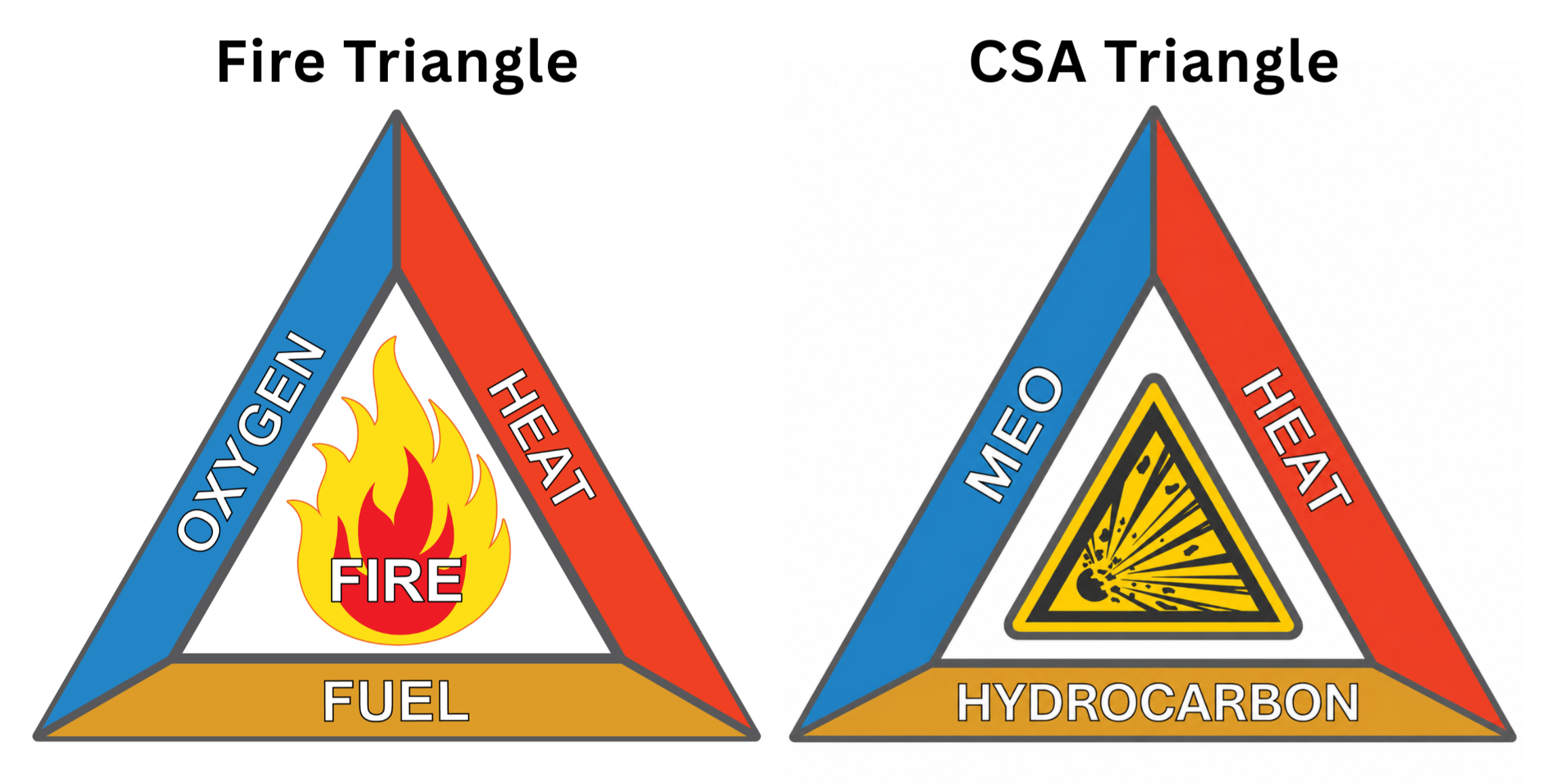
Figure 1: Fire triangle vs. CSA triangle
Understanding the CSA triangle and reaction behavior
The key reaction scheme is:
MeO + Hydrocarbon (+ H2) → Meo + CO2 + H2O
However, intermediate reactions can also take place, including partial oxidation and cracking. Through these reactions the number of small molecules increases, leading to pressure elevation. This can occur rapidly and potentially result in loss of containment.
The elements of the CSA triangle are further explained below.
MeO (Metal Oxide)
Catalysts and adsorbents are often supplied in an oxidized state (fully metal oxide) or pre-stabilized (oxidized outer layer). The first step after charging the reactor is to activate the catalyst via reduction.
Do you know how much oxygen can be present in such a system? Take a fixed-bed reactor with dimensions of 6 m x 1.2 m (19.7 ft x 3.9 ft), loaded with catalyst containing 40% Ni. At pre-activation conditions, the vessel will contain about 2 tons of potentially activated oxygen. The degree of reactivity depends on:
- The type of metal present
- Thermodynamics of the reaction (∆G)
If the reaction of the MeO and a hydrocarbon has a ∆G < 0, reduction can easily take place. The lower the ∆G, the more reactive the oxygen will be.
Hydrocarbon
Catalyst activation before production starts can follow three different Standard Operating Procedures (SOPs):
- Liquid phase activation (Hydrocarbon + H2): Acts as a heat sink, avoiding high temperatures in the catalyst bed during activation
- Gas phase activation (H2-rich hydrocarbon): Slower compared to liquid phase, as the activation heat can only be removed with the gas flow, which has a low heat sink
- Gas phase activation (N2 + H2): Also slow but intrinsically safe, as there is no hydrocarbon present that can react with the MeO
Which SOP to choose depends on both the catalyst system and the options available on site. The type of hydrocarbon makes a difference as well. Feeds of bio origin will contain oxygenates that display a higher reactivity toward MeO compared to, for example, paraffins. Olefins are also prone to oligomeric or polymeric reactions during catalyst activation steps.
Heat
Depending on the combination of MeO and hydrocarbon, reactions become significant at certain temperatures. In reactive hazard experiments, this temperature is defined as Tonset for exothermic reactions or DTOP (Decomposition Onset Temperature based on Pressure) for thermo-neutral reactions that result in pressure increase.
These temperatures can be reached when a heat source is present in the catalyst or adsorbent bed, including:
- Standard heat-up by SOP
- Heat of adsorption
- Unexpected initial reaction
When do CSA risk conditions align?
If all elements of the CSA triangle – metal oxide, hydrocarbon, and heat – are present, the fixed-bed reactor or adsorber is at risk.
Are you aware of the possible safety scenarios in your reactors and adsorbent beds, particularly during transient conditions and process upsets? Becht can support your team in applying Catalyst Safety Assessment by screening systems and Standard Operating Procedures, identifying potential risks, and developing mitigation options. Contact us today to discuss practical next steps.
Reference
1Groendijk, Willem and Buijs, André. “Catalyst Safety Assessment: Making Catalyst and Adsorbent Startups Safer.” Hydrocarbon Processing, July 2024.
Like what you just read? Join our email list for more expert insights and industry updates.