
Cost Cutting vs. Value Creation: The Business Case for Operations Training
Operations training creates measurable business value by improving the quality of decisions made in the field. Better decisions help prevent costly production losses and support safer, more reliable operations.
Key takeaways
- Operations training can prevent costly production losses and operational disruptions.
- Training helps operators recognize abnormal conditions and respond appropriately.
- Lessons learned from industry incidents can improve decision-making in the field.
- Training investments can create measurable value that exceeds their cost.
- Organizations should track operational successes as well as incident investigations to evaluate training effectiveness.
Public companies have shareholders who expect results. Poor performance can affect company valuation and increase pressure on management teams to deliver. Businesses exist to create returns for these shareholders, and regularly evaluating costs is an important part of that responsibility. That naturally leads to an important question: “Are we getting value from this spend?” Training programs are no exception.
A previous Becht blog focused on the broad organizational benefits of training, including higher productivity, fewer errors, increased retention, and lower turnover. Another way to evaluate training is through its impact on operations and the decisions people make in the field. Where is the hard data that proves training is creating day-to-day value for the business?
Measuring training through an operations lens
An operations manager typically wants a training program to deliver:
- Reduced downtime
- Fewer safety incidents
- A lower instance of operator errors
- Consistent performance
Measurements are important to justify keeping training budgets off the chopping block. Many organizations utilize incident investigations as part of their organizational learning process. Most spend time learning from safety incidents to ensure root causes are identified and addressed, and additional training is often one of the corrective solutions offered.
But far fewer organizations examine successes with similar rigor to understand why the right decision was made at the right time. Operators will often point to their training as the reason they recognized a situation and knew what to do. Decisions to cut training become harder if there are clearly tracked indications of tangible benefits.
As an exercise, let’s work through a couple of scenarios where making the correct choice had an impact.
FCC startup training prevents lost production
During the startup of an FCC unit after an outage, the unit was still on torch oil after feed had been introduced, and the downstream fractionation section was still being lined out. The feed system experienced a transient that quickly passed through the system. Immediately afterward, the regenerator started losing temperature.
The unit procedures required operators to add torch oil if the regenerator temperature dropped below below 1250 °F. Torch oil was expected to remain in service until the heavy feed was fully introduced. The board operator and engineer were on the radio with the outside operator verifying that torch oil was still lined up when the engineer left to assist with troubleshooting outside.
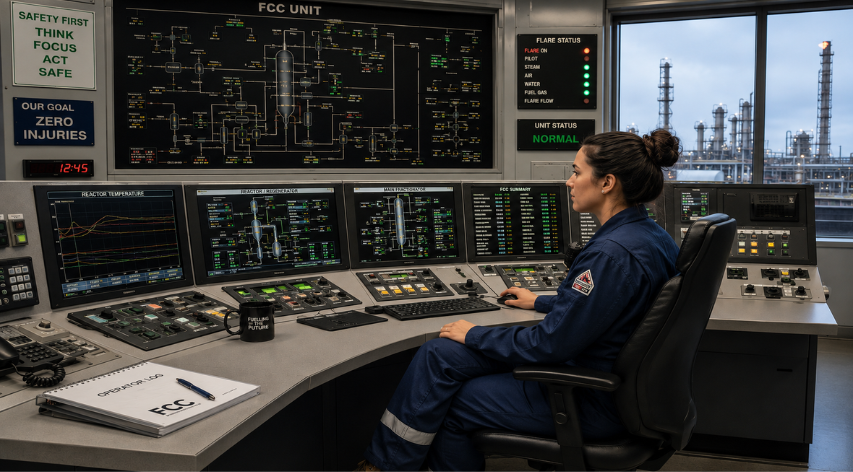
The board operator remembered from heat balance training the previous fall that reducing stripping steam in the catalyst stripper could also heat up the regenerator. She communicated to the team that she was making this move to effectively create her own “torch oil.”
About this time, the outside operator and engineer radioed back to report that the torch oil valve had gotten stuck during the feed transient and that they were working to restore service. If the regenerator temperature had dropped too far, feed would have been pulled and a hot restart required once the issue was understood and addressed to maintain process safety. Following the post-startup investigation, the board operator was recognized for her quick thinking and safe execution.
Avoiding a hot restart procedure eliminated a shift delay and preserved production during a critical startup period. For this 45 kbpd FCC unit operating with a $10/bbl feed incentive, the value of avoiding that delay likely exceeded $200,000. Providing on-site training for operators and engineers cost only a small fraction of the value it helped preserve.
HF alkylation training helps prevent potential exposure
On an HF alkylation unit, operators were completing a sludge transfer to the roll-off bin for holding before it could be pressed to remove excess liquid from the solids. This role was performed by the newest member of the team.
After completing the transfer, he moved on to another task requiring an operating permit. He was verifying air quality when he caught a whiff of H2S and noticed a few ppm on the air monitor, so he left the area to discuss the situation with the chief operator. He mentioned that the sludge transfer had just been completed and recalled a recent HF alky training that covered an industry incident involving H2S during HF alky sludge treatment. The two operators also considered a feed sulfur excursion the unit had experienced the previous month.
Based on that information, the operators decided to don additional PPE and safely investigate the sludge bin under fresh air. Further inspection confirmed that the H2S was clearly emanating from the covered roll-off bin. The area was barricaded to keep personnel at a safe distance, and the bin was moved to a more isolated location and mixed to finish the incomplete neutralization.
Without the right training that included lessons from previous industry incidents, the site could have faced significant injuries or even fatalities. The money invested in the training course directly contributed to a positive result in the field.
Training creates measurable business value
These examples are just a couple of ways training can directly benefit any site. For an operations manager, they make it easier to connect training investments to operational performance. In both instances, reducing the training budget could have cost the site much more in terms of safe, reliable operation than any amount of money saved. Keeping operators up to date on their unit is one way to generate returns. Organizations will also see the dividends of training through their employees feeling valued and deciding to stay for growth.
If you need help developing training KPIs and tracking successes, or if you’d like to discuss building a broader technical competency and mentorship program that can deliver even greater long-term operational value, reach out to Becht today.
Like what you just read? Join our email list for more expert insights and industry updates.