Full Encirclement Sleeve Repairs: How to Evaluate Stress and Ensure Safe Operation
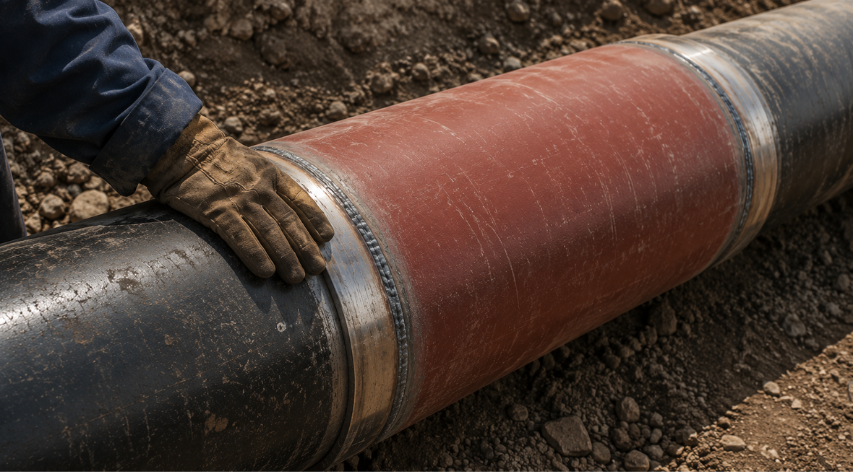
Full encirclement sleeve repairs allow damaged piping and pressure vessels to remain in service, but they also introduce localized stresses that must be evaluated carefully. Analytical stress methods can help engineers assess sleeve integrity more efficiently while maintaining confidence in safe operation.
Key takeaways
- Full encirclement sleeves are commonly used to repair piping and pressure vessels without shutdown.
- Stress concentrations often occur at the pipe-to-sleeve junction rather than in the sleeve itself.
- Internal pressure creates bending moments because the sleeve and pipe have different stiffness and geometry.
- Traditional finite element analysis can be accurate but time-intensive for routine evaluations.
- Analytical stress methods provide faster assessment while maintaining good agreement with FEA results.
Full encirclement sleeve repairs allow damaged piping and pressure vessels to remain in service, but they also introduce localized stresses that must be evaluated carefully. Analytical stress methods can help engineers assess sleeve integrity more efficiently while maintaining confidence in safe operation.
What happens when a pipe wall is no longer thick enough for continued operation, but shutting down the unit isn’t an option? In many facilities, the answer is a full encirclement sleeve. These repairs are widely used across refining and petrochemical operations because they allow operators to address damage while keeping units online.
Full encirclement sleeves are commonly installed to mitigate leakage caused by corrosion or erosion damage, as well as fatigue-related cracking. They’re also used when in-service inspection identifies piping or pressure vessels that no longer meet minimum thickness requirements.
While these repairs are familiar and often effective, they introduce an important engineering question that’s not always fully addressed during design: how do you accurately evaluate the stresses created by the sleeve itself? Understanding this is critical to determining whether a repair will safely support continued operation or simply delay a more serious issue.
This article is based on an ASME PVP conference paper that introduces a practical analytical method for evaluating stresses in full encirclement sleeve repairs.1
Why full encirclement sleeve repairs are widely used
Full encirclement sleeves remain a preferred repair method because they’re practical and adaptable. They can be applied on-stream in certain situations, which reduces downtime, or installed during planned outages as part of a broader integrity strategy.
In many cases, sleeves are treated as temporary repairs intended to last until the next turnaround. However, when designed correctly, they can serve as permanent solutions. This requires that the sleeve be capable of containing the full design pressure and that welds meet applicable code requirements. It also requires careful consideration of how load is transferred between the pipe and sleeve.
Standards such as ASME PCC-2 provide guidance on how to apply these repairs, including expectations for material selection and weld quality. But even with this guidance, a critical aspect of sleeve performance is not explicitly addressed.
The critical challenge: Stress at the pipe-to-sleeve junction
When a full encirclement sleeve is installed, the system no longer behaves as a uniform cylindrical shell. Instead, a structural discontinuity is introduced at the interface between the sleeve and the original pipe or vessel. This change in geometry alters how loads are distributed through the system.
Internal pressure acting on the sleeve generates axial forces. Because the sleeve and pipe have different geometries and stiffness, these forces don’t align perfectly, which results in an eccentric load that creates a bending moment at the junction between the sleeve and the pipe. This bending effect leads to localized stress concentrations, which are often the controlling factor in evaluating the integrity of the repair. The highest stresses aren’t necessarily found in the sleeve itself or in the unaffected pipe, but rather at the transition region where the two components interact.
ASME PCC-2 provides high-level guidance for sleeve design, but it doesn’t include a detailed methodology for calculating stresses at this junction. This means that engineers must rely on other approaches to evaluate whether a given sleeve configuration meets allowable stress limits.
Limitations of traditional stress evaluation methods
One option for evaluating stresses in sleeve repairs is finite element analysis. This approach can capture the interaction between the sleeve and the pipe with a high level of detail and can provide accurate predictions of stress distribution.
The challenge is the level of effort required. Building and validating a model takes time, and achieving an optimal design often requires multiple iterations with different sleeve geometries. This process can become inefficient if several repair scenarios must be evaluated quickly.
Simplified calculations offer a faster path, but they may not fully capture the effects of load eccentricity or structural discontinuity. This creates uncertainty in the evaluation process. Designs may skew more conservative than necessary, or they may underestimate stresses at critical locations. This gap between detailed analysis and practical application highlights the need for a faster and more reliable method to evaluate sleeve stresses.
An analytical method for evaluating sleeve and pipe stresses
To address this gap, an analytical method was developed to calculate stresses in both the sleeve and the underlying pipe or vessel using shell theory.
The approach begins by determining the required sleeve thickness to withstand internal pressure, taking into account allowable stress and joint efficiency. At a basic level, sleeve thickness depends on internal pressure and pipe radius, along with weld efficiency. In simplified form:
t = (P × R) / (σₐ × E)
where pressure, radius, allowable stress, and joint efficiency define the minimum required thickness.
The method then calculates the axial thrust force generated by internal pressure and evaluates the bending moment created by the offset between the sleeve and pipe walls. Using equilibrium conditions together with compatibility of rotation and deflection, it solves for internal forces and moments at the pipe-to-sleeve junction. These results are then used to determine stress in both components, including the effects of pressure and bending. These stresses are combined into a von Mises equivalent stress, which accounts for the interaction between different stress components to evaluate overall failure risk.
Comparison with finite element analysis
To validate the analytical method, results were compared with finite element analysis across a range of pipe sizes and sleeve configurations. The comparison showed that the analytical solution produces results that align closely with FEA predictions. The differences between the two methods fall within an acceptable range for most engineering applications. This demonstrates that the analytical approach captures the key factors influencing stress at the junction.
The method also produces conservative results, which supports its use in design and evaluation where safety margins are important. This level of agreement provides confidence that the method can be used as a practical alternative to more time-intensive analysis techniques.
Practical benefits for engineering and operations teams
For engineers working in operating facilities, decisions about sleeve repairs are often time-sensitive and closely tied to production and safety considerations. Having a reliable way to evaluate stresses quickly can improve both speed and confidence in decision-making.
This analytical approach enables faster assessment of repair options and reduces reliance on complex modeling for routine cases. It also provides a consistent framework for evaluating compliance with allowable stress criteria. Engineers can explore different sleeve configurations more efficiently, which supports more effective repair design.
By focusing on stress behavior at the pipe-to-sleeve junction, the method addresses the area that most strongly influences the integrity of the repair. This helps ensure that sleeve installations are practical and structurally sound under operating conditions.
A more reliable approach to sleeve repair design
Full encirclement sleeve repairs play a critical role in maintaining the integrity of piping and pressure vessels in operating facilities. While existing standards provide essential guidance for their application, evaluating the stresses introduced by these repairs requires additional analysis.
The analytical method presented here offers a practical way to address that challenge. It provides a faster and more accessible approach to calculating stresses at the pipe-to-sleeve junction, while maintaining good agreement with finite element analysis. By improving how these stresses are evaluated, engineers can make more informed repair decisions and reduce uncertainty, with a clearer path to safe operation over the life of the asset.
If you’re evaluating a sleeve repair or want a second look at an existing design, Becht’s subject matter experts can help you assess stresses and make confident decisions for continued operation. Contact our team to discuss your specific application.
Reference
1Nadarajah, C. An Analytical Solution Based on Shell Theory for Calculating Stresses on Full Encirclement Sleeves Used on Pipes and Pressure Vessels. ASME Pressure Vessels and Piping Conference, 2016.
Like what you just read? Join our email list for more expert insights and industry updates.